
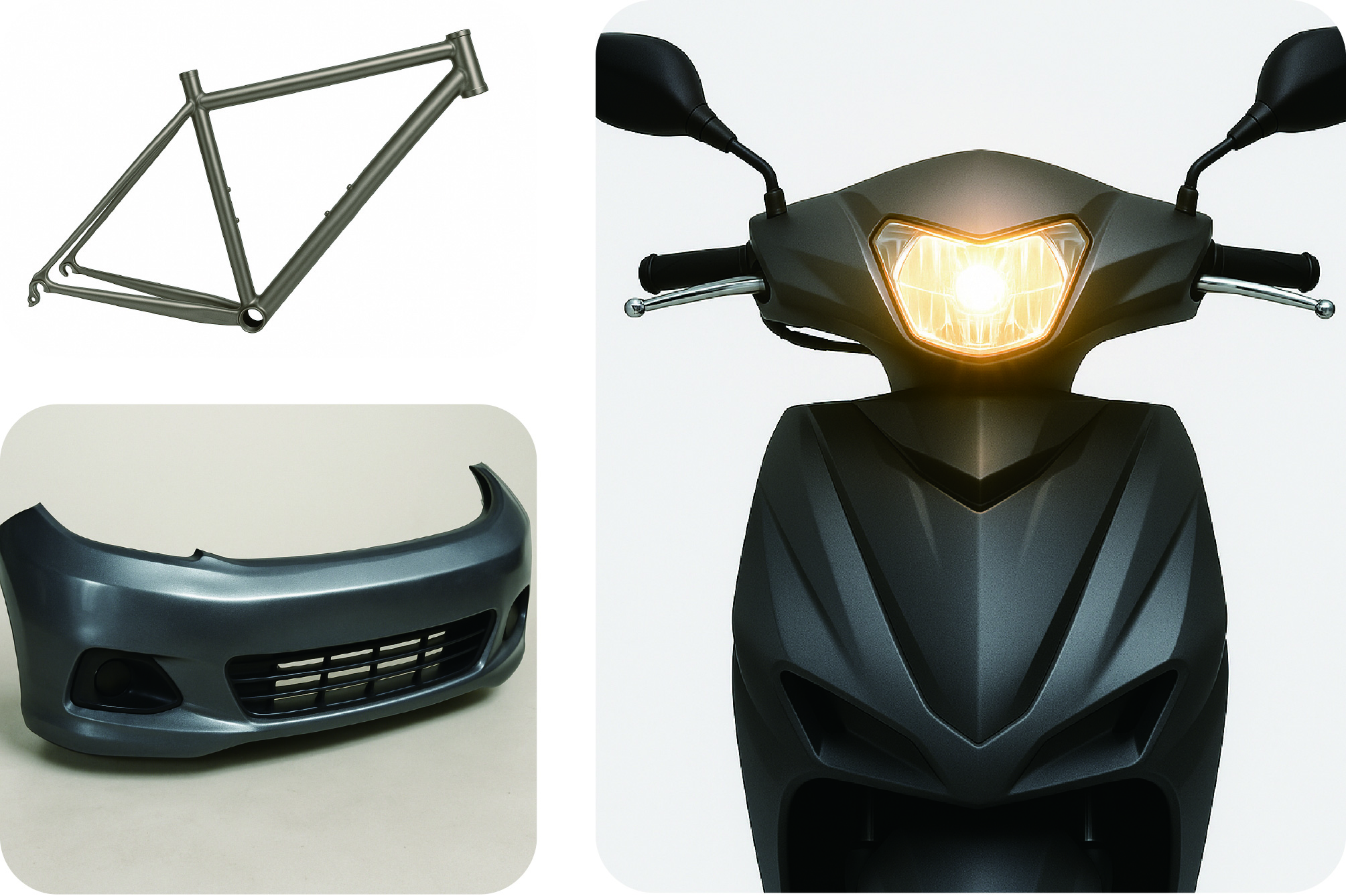
Lighter structures, smoother lines—shaping the future of mobility through precision printing.
Metal 3D printing enables lightweight, high-strength mobility components with precise fit, delivering micron-level accuracy across automotive and vehicle applications.
- Vehicle light housings
- Automotive bumpers
- Bicycle frames
Why Choose HTT?
HTT specializes in metal 3D printing and end-to-end mold manufacturing, delivering high-precision, production-ready solutions. By integrating design, simulation, fabrication, and post-processing, we reduce coordination effort, control cost and risk, and shorten development time by over 30%.
From complex designs to rapid iterations, HTT is not just a supplier, but a trusted manufacturing partner.
FAQ
1. What level can be achieved?
From bicycle connectors and structural brackets to thermal management components, every detail is produced with micron-level precision, achieving the perfect balance between technology and speed.
2. What are the common metal 3D printing technologies?
- SLM(Selective Laser Melting) / DMLS(Direct Metal Laser Sintering):Uses a high-power laser to selectively melt metal powder, delivering high precision and high part density, suitable for engineering applications.
- EBM(Electron Beam Melting):Uses an electron beam to melt metal powder in a vacuum environment; suitable for high-temperature materials such as titanium alloys, offering high build speed but a relatively rough surface finish.
- DED(Directed Energy Deposition):Uses a laser or electron beam to simultaneously melt metal powder or wire, enabling part repair and large-scale printing.
- Binder Jetting(Metal Binder Jetting):Uses a binder to bond metal powder, followed by sintering; offers low cost and high speed but requires additional post-processing.
3. What are the application areas of metal 3D printing?
The flexibility of metal 3D printing enables outstanding performance across a wide range of industries:
- Aerospace:Manufacturing lightweight, high-strength structural components such as turbine blades and brackets to reduce aircraft weight.
- Automotive:Producing performance parts, engine components, exhaust systems, and even racing parts.
- Mold Manufacturing:Rapid fabrication of molds with complex cooling channels to improve cooling efficiency and extend product life.
- Jewelry and Art Design:Creating intricate forms that are difficult or impossible to achieve with traditional casting methods.
Contact us to unlock new possibilities in mold manufacturing!
Get in touch with us and let’s build an innovative manufacturing future together.